
Small Spaces
Room Divider Ideas That Don't Need a Single Nail

Photo by Nastuh Abootalebi on Unsplash
The best room divider ideas for a living room, studio, or shared bedroom get you real room separation without a single hole in the wall — a folding screen, portable wall dividers, a curtain on a track, or furniture you already own will do it for $0–150. Below are 13 ways to do it, roughly in order of cheapest and most reversible to most permanent, so you can stop where your lease (and your patience for assembly) says to.
Hang a folding screen for privacy you can move in an afternoon
A folding screen — sometimes sold as a dressing screen — is the fastest, most genuinely portable room divider on this list: no tools, no mounting, no measuring the ceiling for a track. Three or four hinged panels stand on their own weight and fold flat against a wall when you don’t need them, which makes this the only idea here you can un-decide by Tuesday.
A basic three-panel screen in wood, rattan, or upholstered fabric runs $60–150 depending on height and material — go at least 5.5 feet tall, or it reads as decoration instead of an actual divider. A single panel is occasionally enough to soften a narrow hallway or reading nook, but a full room needs the whole set. (We’ve bought the 4-foot version once. It divided nothing except our expectations.)
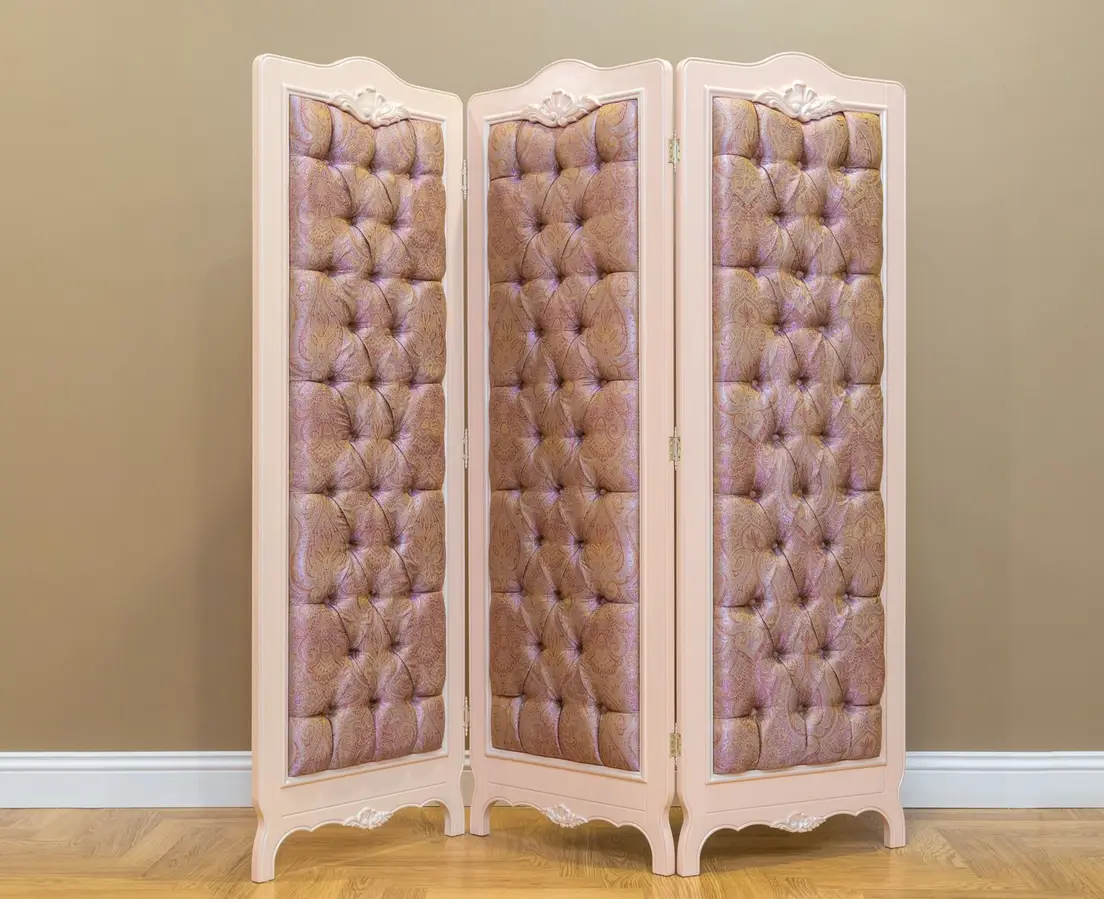
Photo by Max Vakhtbovych on Pexels
Divide a room with curtains and a track — zero holes in the wall
A ceiling-mounted curtain track with a floor-length panel is the room divider equivalent of a closet: fully open when you want the space back, fully closed when you don’t. Unlike a screen, it can run the full width of a room, which matters in a studio where the “wall” you’re building needs to reach corner to corner.
A track kit runs $30–60 and a heavyweight curtain panel adds another $25–50; adhesive-mounted tracks exist for the no-drill version, though they hold less weight, so check the rating before you hang a thick blackout panel from one. Renter-friendly on a label means nothing without a stated weight limit — read the fine print, not the marketing copy.

Photo by Justin Schüler on Unsplash
Turn a bookshelf into a room divider that earns its keep as storage
A bookcase used as a room divider does two jobs a screen or curtain can’t: it holds the books you already own, and it reads as furniture instead of a wall you built to hide something. It’s especially useful between a living room and a dining nook, where you want a visual break but not a closed-off room. Open-backed shelving lets some light through both sides, which keeps a small apartment from feeling like it’s been cut into two dim halves.
A 5–6 foot open bookcase runs $80–200 depending on material, and it’s genuinely a two-person flat-pack job — we’ve assembled one solo on a Sunday afternoon because “how hard can it be,” and the instructions were right about needing a second set of hands for step nine. Anchor it to the wall regardless of which side faces “public,” since a freestanding shelf that size is a tip hazard once it’s loaded with books.
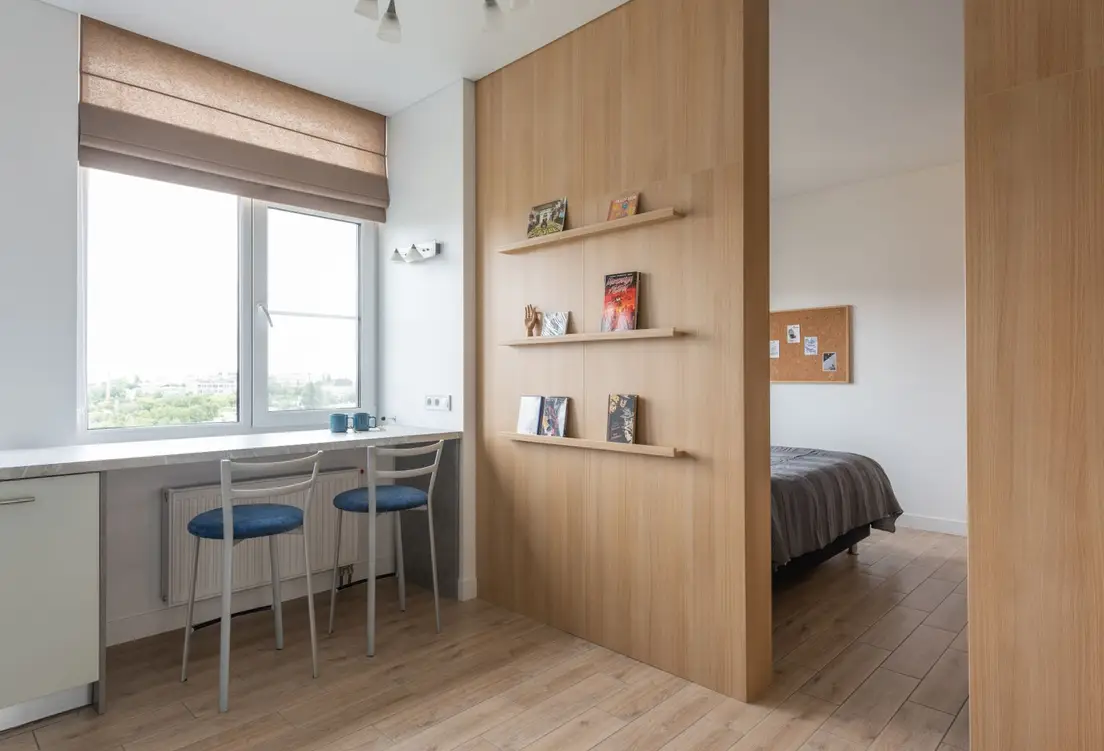
Photo by Max Vakhtbovych on Pexels
Install a sliding door for full-height separation without hiring a contractor
A track-mounted sliding door — the barn-door style or a slim aluminum-and-glass panel — is the closest this list gets to an actual wall while still counting as furniture in most leases, since it typically mounts to an existing header or a freestanding frame rather than the drywall itself. It closes a room off completely, sound included, in a way nothing fabric-based on this list can match.
A kit with hardware and a basic panel starts around $200 and climbs past $500 for glass or solid wood; confirm with your landlord before mounting anything to the ceiling structure, since this is the one idea here that edges closest to “permanent” even though the door itself unhooks in ten minutes.
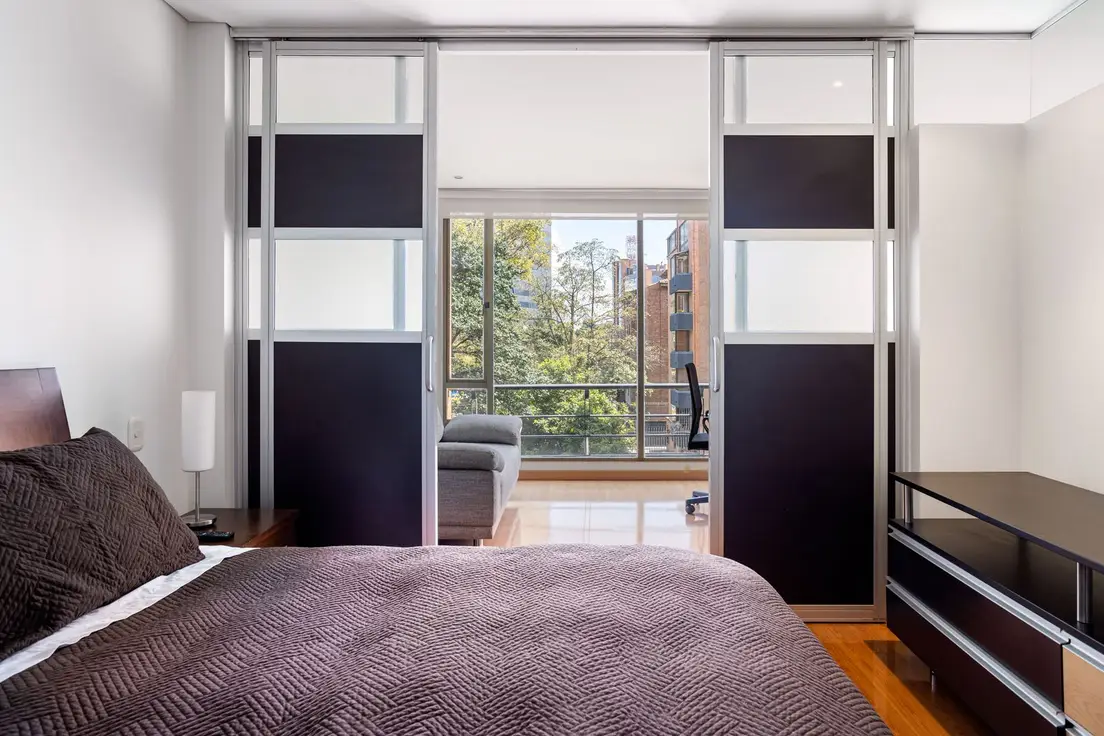
Photo by Gustavo Galeano Maz on Pexels
Let existing furniture do the dividing before you buy anything new
Live with the room for a week before ordering a divider — half of what feels like “I need to split this space” is actually “I need to rearrange what’s already in it,” and rearranging is free. A geometric shelf, a console table, or even a sofa turned to face away from the “other” zone reads as an intentional boundary the same way a purpose-built divider does, minus the shipping box.
This is the highest-leverage idea on the list precisely because it costs nothing: walk the room, decide where the line actually needs to fall, and try floating one piece of furniture along it before buying a single new object.
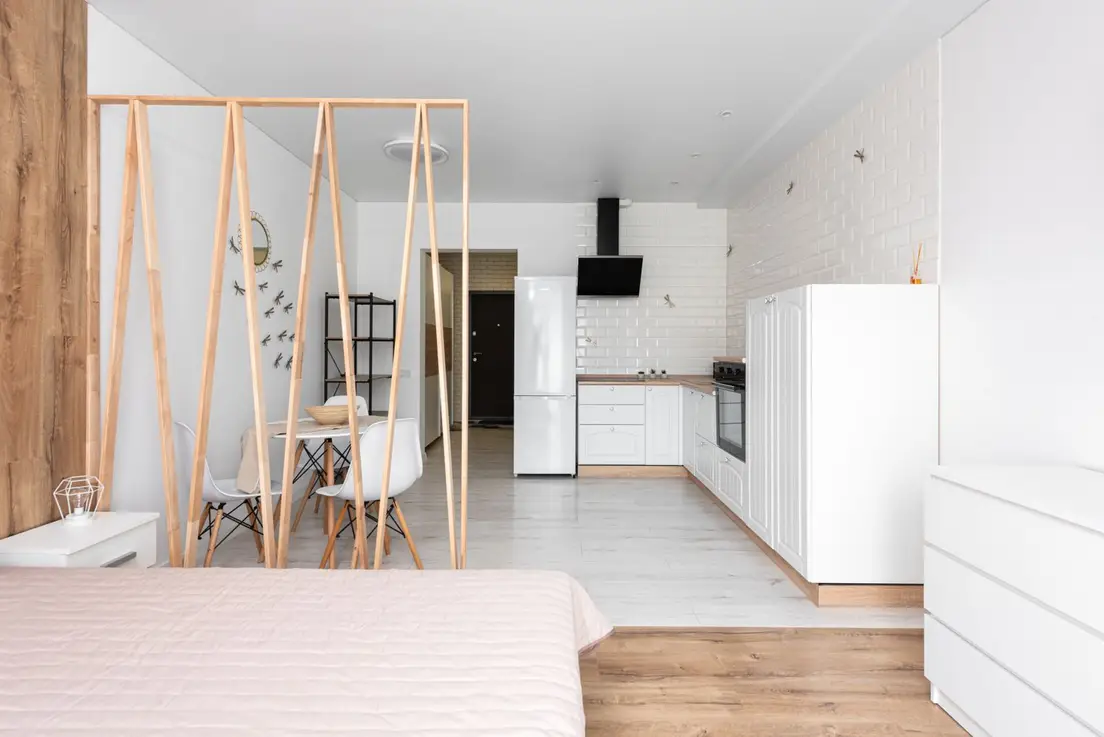
Photo by Max Vakhtbovych on Pexels
Zone a studio bedroom corner with a shelf-and-console divider
A studio’s hardest problem is the bed, in full view, from the front door. A low, stylish console or open, freestanding room divider placed at the foot of the bed — not against a wall, but out in the room — draws a line the eye respects even though nothing’s actually blocking it, and it does double duty as a TV stand or plant shelf for the “living” side.
Keep it under chest height so the room still reads as one open space from the doorway; a divider tall enough to fully block the bed starts working against the studio’s actual selling point, which is the open floor plan you’re paying for.
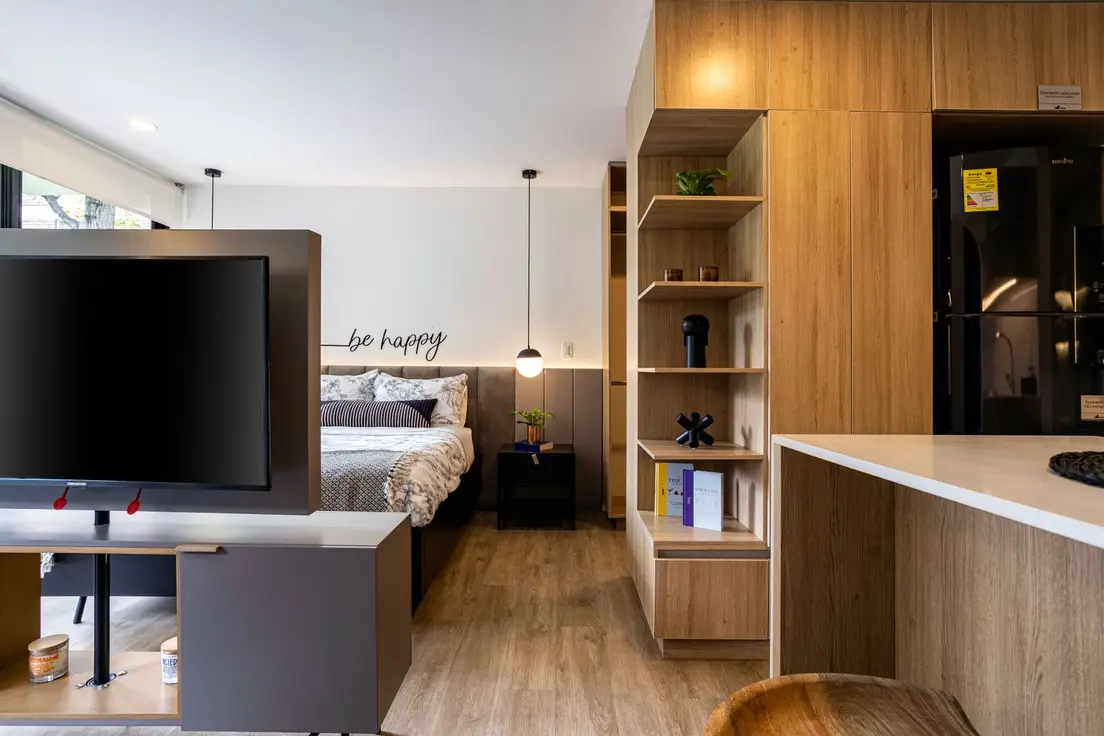
Photo by Gustavo Galeano Maz on Pexels
Choose a woven panel for texture without blocking the light
A rattan, bamboo, cane, or woven-wood panel splits a room the way a screen does but reads warmer and lets natural light filter through the weave instead of casting one hard shadow line. It’s the option to reach for when the space already leans natural-materials — a lot of exposed wood, linen, jute — since a solid opaque screen would look like it wandered in from a different apartment.
Panels run $40–120 for a single freestanding piece, cheaper than an equivalent-size upholstered screen, and the natural material hides scuffs a painted surface wouldn’t. These are built for indoor use only — the weatherproofed outdoor version is a different, pricier product.

Photo by Pandu Genius on Unsplash
Use a glass or acrylic panel when you want separation, not a wall
An architectural glass or frosted-acrylic panel divider does something none of the fabric or wood options can: it splits the floor plan without splitting the light. A bedroom behind a glass panel still gets the window on the other side of the apartment, which matters more than it sounds like it should in a unit with only one real light source.
Framed glass panels start around $150 for a small freestanding piece and climb fast for anything floor-to-ceiling or sliding; frosted or reeded glass trades a little privacy for a lot less “someone can see my unmade bed from the kitchen.”
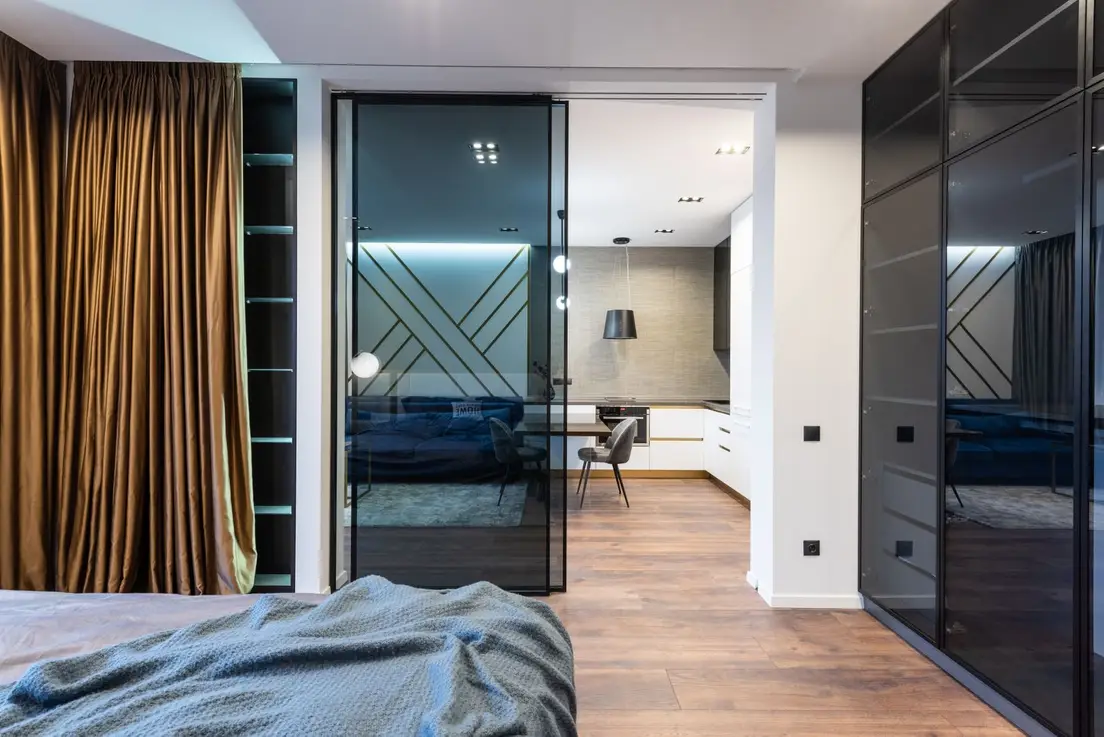
Photo by Max Vakhtbovych on Pexels
Pick multi-functional furniture that divides the room and works overtime
A desk backed with an open shelving unit, or a daybed with a bookcase headboard, does the work of a room divider and a piece of furniture you needed anyway — one purchase, two jobs, and one less object crammed into a floor plan that doesn’t have room for both a divider and a bookshelf. This is the option worth reaching for first in the smallest units, where every square foot of floor space is doing overtime already.
Expect to pay a premium over a single-purpose version of either piece — $150–350 for a genuinely sturdy desk-and-shelf combo — but it’s cheaper than buying a divider and a bookshelf separately, and it’s the one idea on this list that never has to be “put away.”

Photo by Israa Hilles on Unsplash
Rent a real temporary wall kit when you need near-permanent separation
A modular temporary wall — telescoping poles that pressure-fit floor to ceiling, with a panel or door insert — gets you the closest thing to an actual second room without a single fastener into the structure. It’s the option for a home office that needs to fully close a door on video calls, not just visually zone the corner.
Kits run $300–800 depending on width and whether you add a door insert, and installation is genuinely a two-person, one-afternoon job, not a contractor call. Some brands also sell a single-pole portable partition version for a narrower gap, which needs less bracing and less of a lease conversation. This is also the idea most likely to trip a clause about “structural changes,” so read the fine print before the kit ships, not after it’s up.

Photo by cottonbro studio on Pexels
Build a cheap DIY partition wall if you actually own the place
Everything above this point works whether you own or rent. A framed drywall partition doesn’t — it’s a real construction project, permit rules depending on your city, and only makes sense if you’re not moving in the next couple of years. If you own the unit and want a true floor-to-ceiling split, this is worth it; if you’re renting, skip straight past this one and back up the list.
A basic non-load-bearing partition runs $300–600 in materials for a standard-size room if you’re doing the framing and drywall yourself, plus real time — this is a multi-weekend project, not an afternoon one, and it’s the one idea on this list we’d tell a renter to skip entirely.
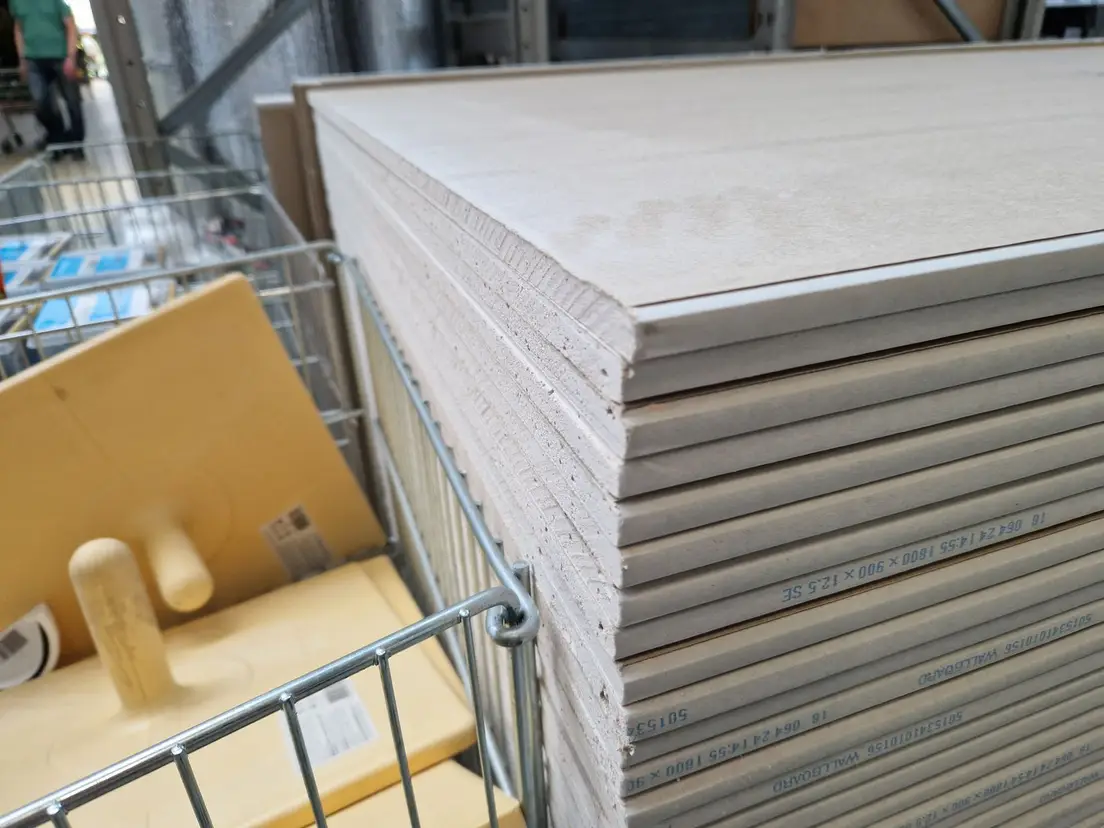
Photo by Pablo Fernandez on Pexels
Check your lease before anything semi-permanent goes up
Property managers and HOAs regulate more of a rental than most people expect, and a room divider is exactly the kind of project that can quietly cross from “furniture” into “structural change” depending on how it’s mounted. A ceiling-anchored curtain track is almost always fine; a temporary wall kit that braces against the ceiling is a gray area worth a two-line email before it ships, not after.
We’ve had a “temporary” structure come down within a week of going up once, over a rule nobody checked first — it’s a faster fix to ask than to redo. Most leases only restrict permanent changes (paint, drilling, anything requiring a patch on move-out), so the freestanding and curtain-based ideas above are safe in nearly every rental; the temporary wall kit and the sliding door are the two worth a quick check.
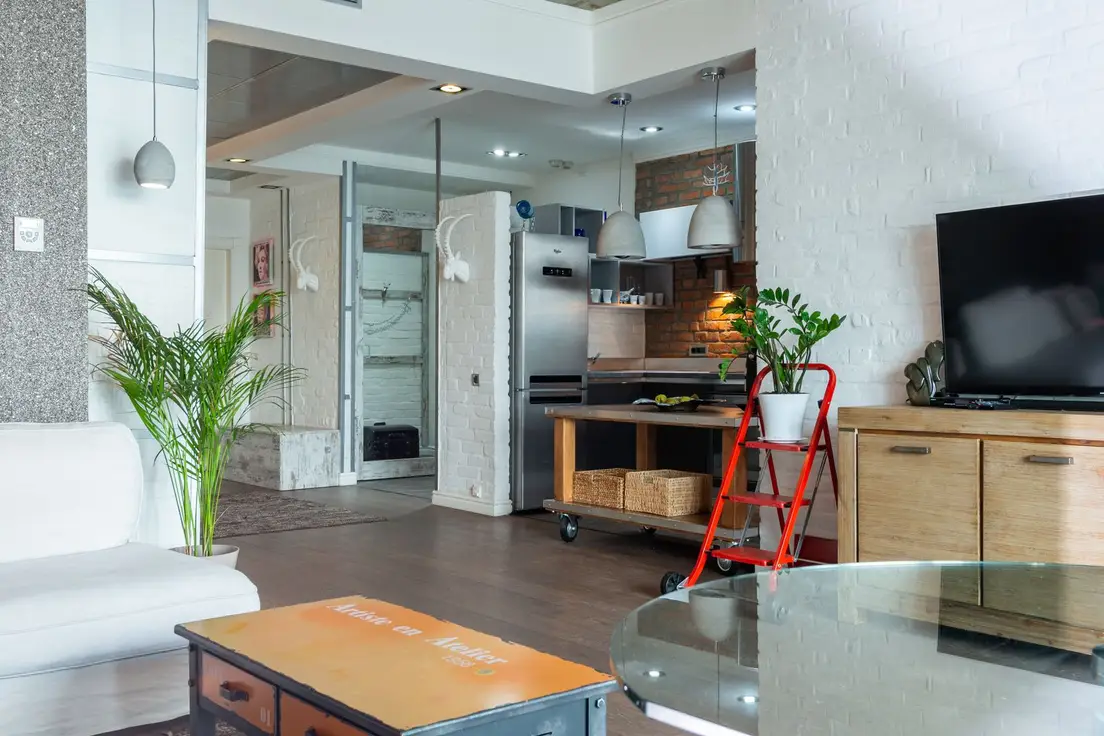
Photo by Max Vakhtbovych on Pexels
The honest math: what a decent room divider actually costs
Here’s the honest math across every idea on this list: a curtain track ($55–110) and a folding screen ($60–150) sit at the cheap end; a bookshelf or woven panel ($80–200) is the mid-tier that also earns its keep as storage; a sliding door or temporary wall kit ($200–800) is the splurge that gets you the closest thing to a real second room. None of them require the DIY partition’s $300–600-plus and multi-weekend commitment unless you actually own the place.

Photo by Siora Photography on Unsplash
Start with whatever’s cheapest and most reversible for your specific lease — a curtain track or a folding screen. Everything else on this list is worth the extra money only once you’re sure the zoning actually needs to be permanent.
Frequently asked questions
What is the cheapest way to partition a room?
A tension curtain rod and a floor-length curtain panel is the cheapest real option, usually $25–50 total, with zero tools and zero holes. A folding privacy screen is a close second at $60–150 and has the advantage of standing up on its own without a rod or track.
What can I use to divide a room into two?
Furniture you already own — a bookshelf, a console table behind a sofa, a tall shelving unit — does the job for $0 if you're willing to rearrange first. Beyond that, folding screens, curtains on a track, and sliding barn-style doors cover most rentals; a framed partition wall is the option if you own the place and want a permanent split.
How do I build a room divider myself?
The simplest DIY build is a curtain track mounted to the ceiling with a floor-length panel hung from it — no woodworking required, just a drill (or adhesive track for a no-drill version) and about an hour. A step up is a freestanding wood-and-fabric folding screen, which needs basic hinges and roughly an afternoon.
What to use instead of a room divider?
Furniture placement is the real answer most of the time — a sofa with its back to the 'other' zone, a rug that visually ends one area and starts another, or a bookshelf that already needed a home. These solve the same zoning problem as a dedicated divider without adding a new object to the room.
Are there room divider options that don't require drilling or permanent installation?
Yes — folding screens, tension curtain rods, freestanding shelving, and furniture rearrangement all skip drilling entirely. Even a 'temporary wall' kit from a company like Room Dividers Now or Wallter uses telescoping pressure-fit poles rather than screws into the ceiling, which is worth confirming with your lease before you order one.