
Kitchen & Dining
Modern Rustic Farmhouse Kitchens: 12 Budget Ideas

Photo by Franco Debartolo on Unsplash
Modern rustic farmhouse kitchens mix clean-lined cabinetry with at least one obviously rustic material — a farmhouse sink, stained wood, exposed beams — instead of picking one lane and staying in it. None of the twelve ideas below need a full remodel; most are a weekend and under $150, and the priciest one still costs less than a single new upper cabinet. The style has held up better than most kitchen trends precisely because it’s a mix, not a rulebook: a builder-grade kitchen can borrow two or three of these moves without ever touching a permit. Think of it as a farmhouse kitchen design built from a country kitchen’s warmth and a modern kitchen’s function, applied to whatever kitchen space you’re actually standing in.
Two-Tone Cabinetry: Painted Uppers, Stained Wood Lowers
Painting only the upper cabinets white and leaving the lowers (or just the island) in a stained or dark wood tone is the fastest way into this look without touching every door in the kitchen. A gallon of cabinet-grade paint runs $45–65 and covers most kitchens’ worth of uppers; the lowers just need a light sand and a coat of tinted wood conditioner if the existing wood tone is already close to what you want. Painting only the uppers is the kitchen equivalent of a shirt-and-tie video call — half the effort, all of the visible payoff. If the lowers are currently painted too, a wood-look contact paper or a full strip-and-restain is the honest fallback, at $80–150 in materials for a standard run of base cabinets. Stick to one wood tone and one paint color across the whole kitchen — mixing a warm oak lower with a cool-gray upper is the fastest way to make a deliberate choice read like an unfinished project. This is the one idea that turns a plain set of kitchen cabinets into a genuinely farmhouse-style kitchen faster than anything else on this list, because it changes the whole room’s read from a single glance in the doorway.
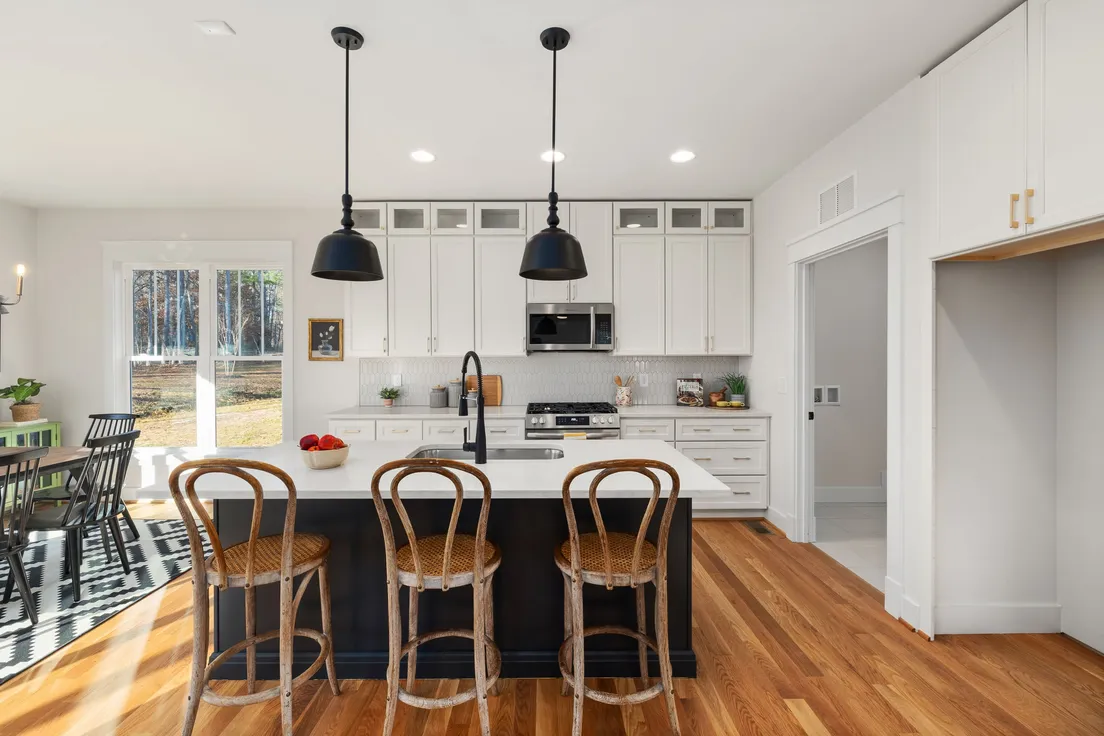
Photo by Curtis Adams on Pexels
Add a Farmhouse Sink Without a Full Renovation
A farmhouse sink is the single most recognizable piece of hardware in this style, and it’s a swap, not a remodel, if the cabinet run underneath can be reinforced. A stainless kitchen sink in a bowl-in-bowl style does the job; a farmhouse apron sink is the one piece of hardware that photographs like the whole kitchen changed, even when it’s the only thing that did. Basic stainless apron sinks start around $250–400; fireclay runs $400–700 and holds its finish longer under daily scrubbing. The real cost isn’t always the sink — a farmhouse sink should rest on a structural support system built into the cabinet, not on the countertop, adhesive, or the drain pipe, according to Matrix Sinks’ cabinet-support guide, so budget for a carpenter’s hour if the existing base cabinet wasn’t built for one. That reinforcement cost is the one line item worth confirming before you fall in love with a specific sink online — an oversized fireclay basin on an unreinforced cabinet is a return, not a renovation.

Photo by Clay Banks on Unsplash
Swap In Open Shelving for an Easier Farmhouse Look
Two or three floating wood shelves in place of a run of upper cabinets read farmhouse instantly, and it’s one of the better farmhouse kitchen ideas for an open plan kitchen where the shelving is visible from the living room too — a pair of 36-inch reclaimed-look shelves with brackets runs $60–120, plus an afternoon with a stud finder. Open shelving isn’t storage, it’s a dare: every mismatched mug and chipped bowl is now on display, on purpose, which is either the whole appeal or the reason to edit the cabinet first. Keep what’s visible to plates, glassware, and two or three plants or jars — the rest stays behind a door. Cast-iron brackets in black or bronze tie the shelves to the same hardware finish as the rest of the kitchen, which matters more than the shelf material itself for making the look feel planned instead of half-renovated. It’s the fastest route to a genuine farmhouse feel for anyone who isn’t ready to commit to a full cabinet swap.

Photo by Odiseo Castrejon on Unsplash
Add Butcher Block Countertops on a Budget
Butcher block is the warmest, most budget-friendly countertop swap in this whole farmhouse design — a standard 25-inch-deep birch or acacia slab runs $8–15 per linear foot unfinished, well under the $50–100+ per square foot most stone and quartz options run. (We’ve set a hot pan straight onto a laminate counter exactly once. The laminate has never forgiven us.) A butcher block counter takes a knife nick or a water ring in stride if it’s sealed with food-safe mineral oil every month or two; skip it entirely on a counter that sits wet for long stretches, like directly around a farmhouse sink, unless you’re diligent about wiping it dry. A small run — just the island, not the whole perimeter — is the easiest place to try it first, since it takes the most daily wear-and-tear love anyway.
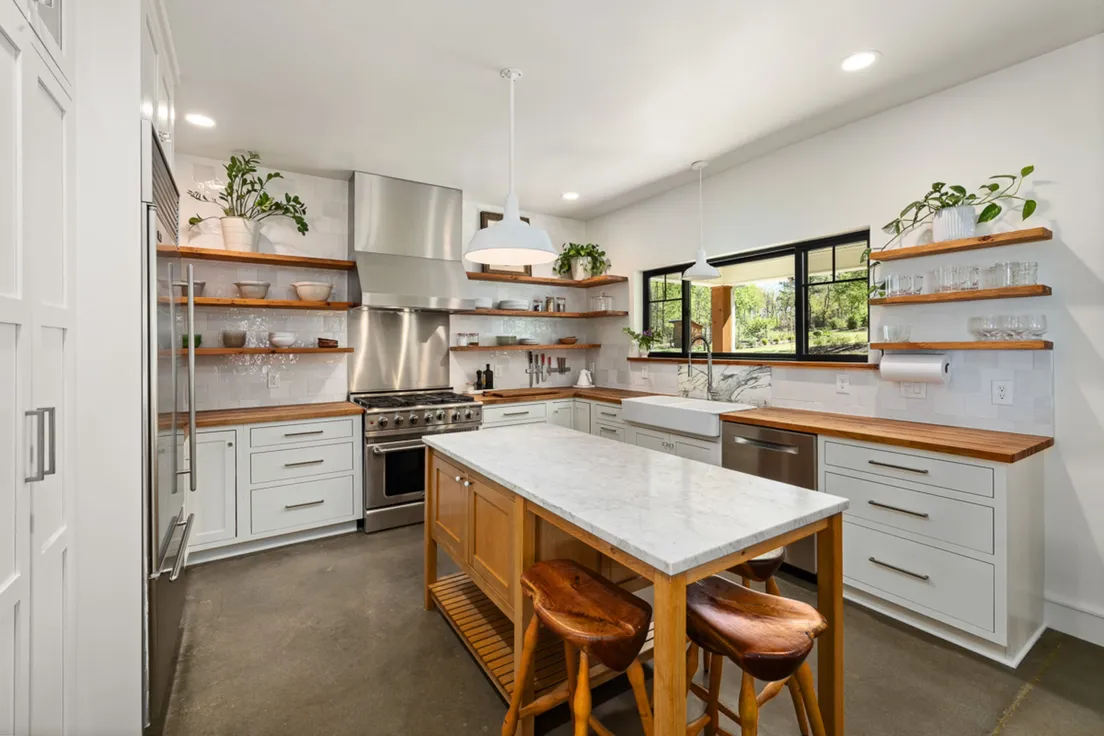
Photo by Curtis Adams on Pexels
Switch to Black Matte Hardware and a Black Faucet
Builder-grade kitchens from the 2000s and 2010s share the same tell: brass or polished-nickel hardware nobody actually chose. Swapping the pulls and knobs for black matte is the fastest, cheapest way to make a kitchen stop announcing its birth year — a full set for a standard kitchen (20–30 pieces) runs $40–80, and it’s a Saturday-afternoon job with a screwdriver and a tape measure to keep the spacing consistent. A black or matte-bronze faucet is the second half of the swap, at $90–200 depending on whether it’s a simple gooseneck or a pull-down sprayer, and it does more to modernize a farmhouse sink than any other single change on this list. Keep the finish consistent between hardware, faucet, and any exposed hinges — a warm-toned black pull next to a cool-toned black faucet reads less like a design choice and more like two separate Amazon orders that arrived a month apart.
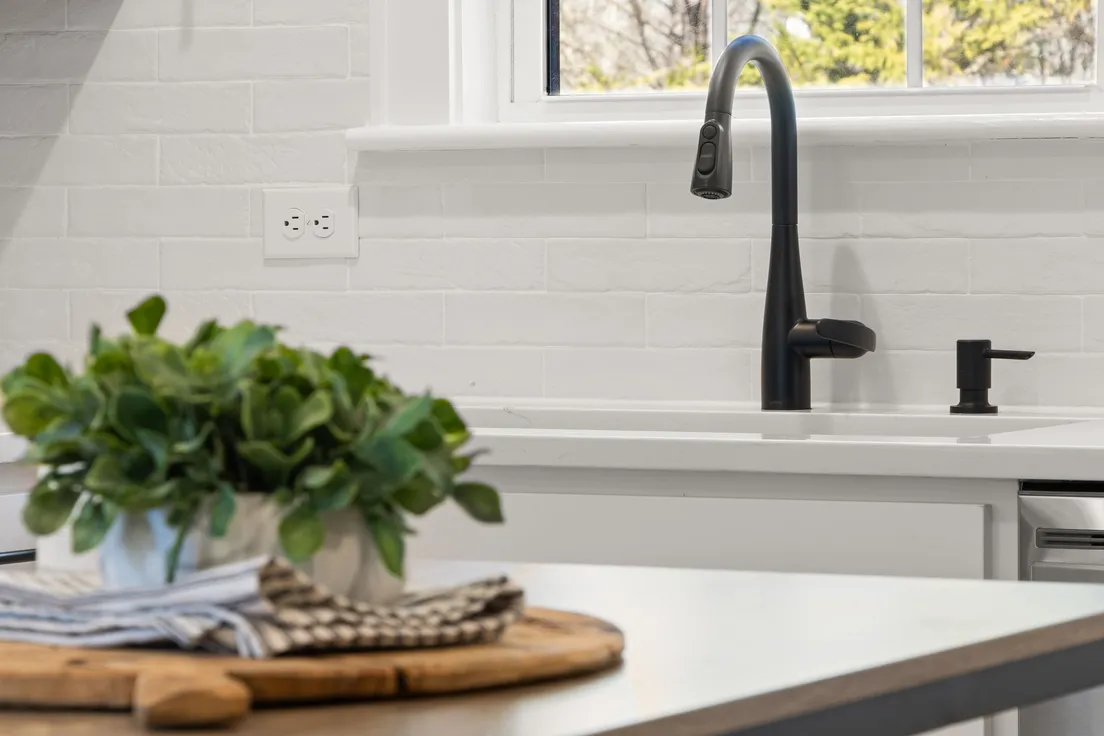
Photo by Curtis Adams on Pexels
Add Shiplap for an Instant Farmhouse Backsplash
A shiplap or beadboard accent wall behind open shelving or a stove hood is one of the most recognizable farmhouse details, and peel-and-stick shiplap panels get most of the way there for renters at $25–40 per section. Peel-and-stick is genuinely good now, but only on the right surface — it’s not permanent-proof. We put peel-and-stick tile up over a rental backsplash once, and the two tiles closest to the stove started curling at the edges within six months from heat and steam; the rest of the wall, out of direct range, still looks perfect years later. Keep peel-and-stick shiplap on a side wall or behind open shelving, not in the direct heat path behind a range, and it’ll outlast the lease. For the wall directly behind the stove, real painted beadboard or a heat-rated tile is worth the extra cost and the extra weekend.
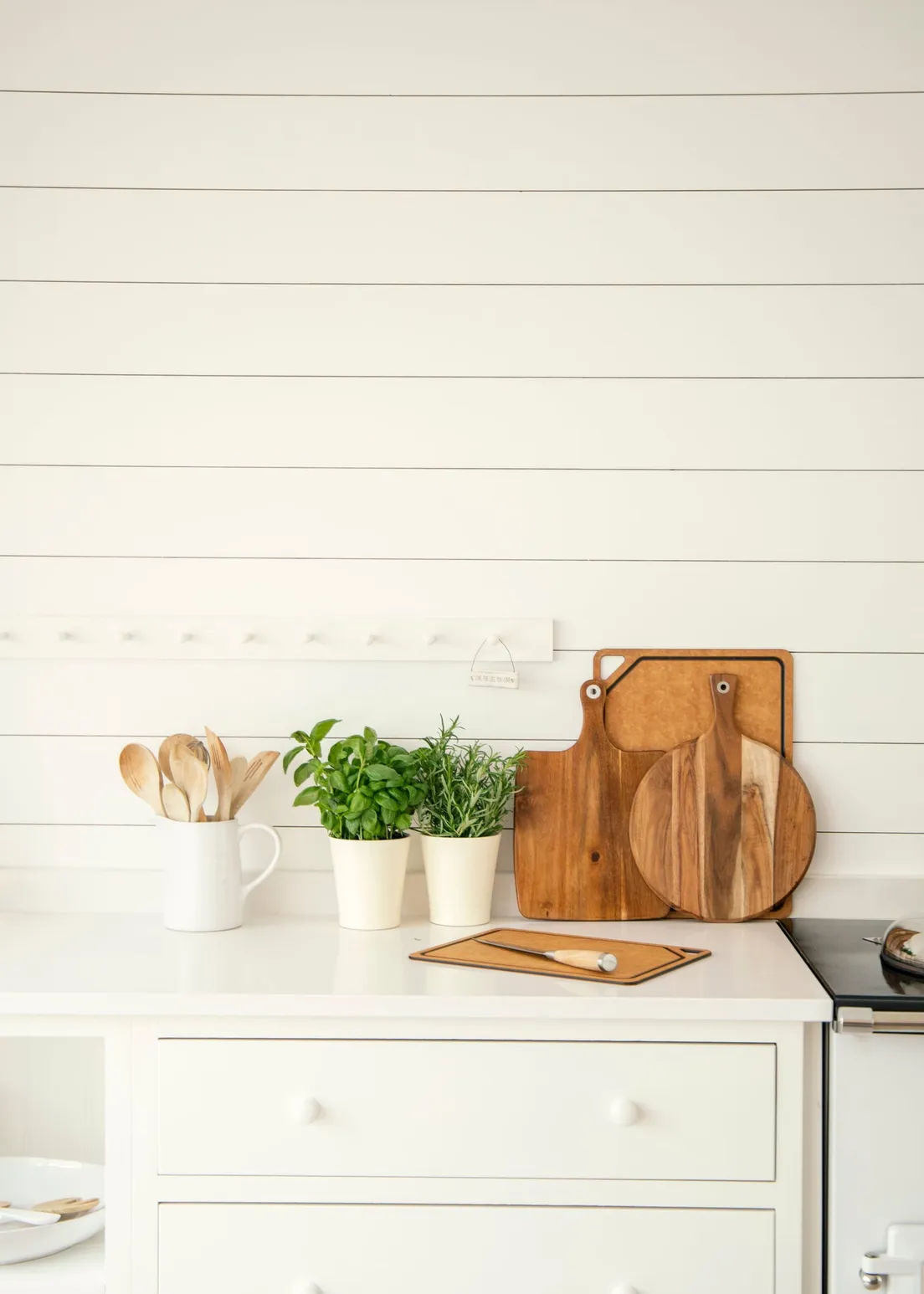
Photo by Georgie Devlin on Pexels
Fake an Exposed Beam for Rustic Farmhouse Charm
A real structural beam isn’t happening in a rental or most single-story ranch kitchens, but a lightweight faux beam — foam-core or hollow wood-veneer — mounts flush to the ceiling with construction adhesive and a few discreet screws into the joists, at $40–90 for a standard 8-foot beam. A faux beam glued to the ceiling does ninety percent of the visual work of a real one, for none of the structural paperwork. One beam centered over the island or the sink run is usually enough; more than two in a small kitchen starts to feel like a themed restaurant instead of a real house. Match the beam’s finish to the darkest wood tone already in the room — the island, the open shelves, or the table — so it reads like it belongs instead of like an accessory bolted on afterward.
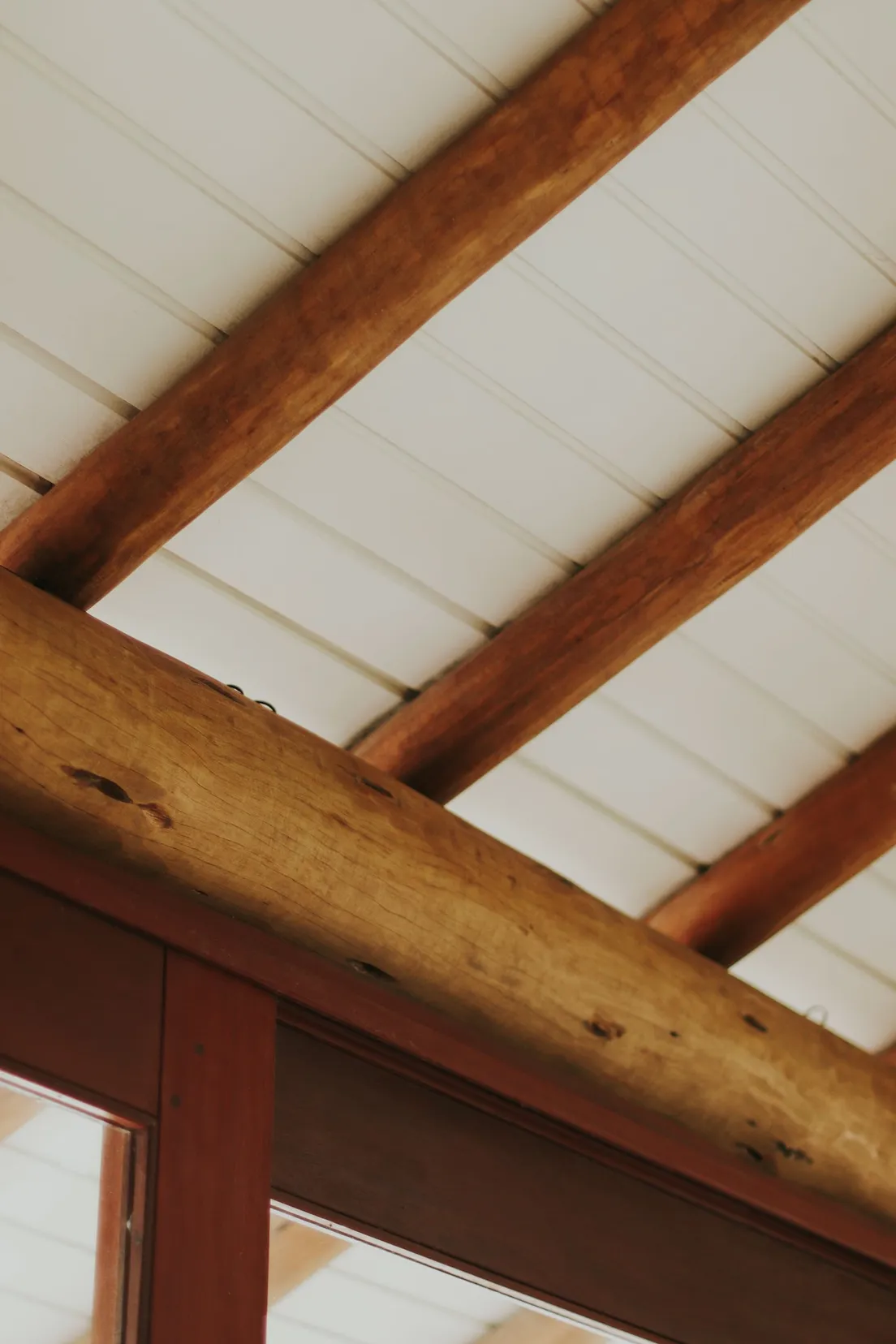
Photo by Letícia Alvares on Pexels
Set a Farmhouse Table With Mismatched Chairs
If the kitchen has room for a table, skip the matching dining set. Six matching chairs read like a showroom; six chairs that don’t match read like the table’s actually been used. A secondhand farm table runs $150–400 depending on size and condition, and a mismatched set of four to six chairs — thrifted, or one style painted two different colors — usually costs less than a single new matching set from a furniture store. (Measure the actual doorway and stairwell before you buy anything over 24 inches wide. We speak from experience.) A tablecloth or a table runner in a checked or ticking-stripe pattern does most of the remaining visual work if the table itself is a plain hand-me-down rather than a true farmhouse piece.

Photo by Clay Banks on Unsplash
Add a Farmhouse-Style Plate Rack or Open Hutch
A wall-mounted plate rack or a small freestanding hutch does double duty as storage and as the single most farmhouse-coded object you can add to a kitchen. A basic wood plate rack runs $60–120; a secondhand hutch — the more genuinely antique the better — usually costs less than a new equivalent piece from a furniture retailer and comes with the dents that make it look collected rather than delivered last week. A small lantern-style pendant is an easy piece of kitchen lighting to add over the hutch, finishing the corner without adding another outlet. An open plate rack turns “we haven’t unpacked yet” into “we did this on purpose” — the difference is entirely in whether the plates are stacked evenly or just leaning. A mismatched set of vintage plates, mugs, and pitchers actually looks more intentional on open display than a matched modern set does — the imperfection is the point, not a flaw to hide.

Photo by Ellen Tanner on Unsplash
Layer In Woven and Wicker Textures for a Modern Farmhouse Kitchen
Rattan or woven bar stools, a jute or wool-blend runner in front of the sink, and a couple of natural-fiber baskets for produce or dish towels add the textured half of “modern rustic” without touching a single fixed surface. Two rattan counter stools run $50–90 each and swap in for whatever’s currently at the island in twenty minutes. One rattan stool reads intentional; three reads like a tiki bar wandered in and never left — stick to what fits the island and stop there. A jute runner in front of the sink ($25–45) and one or two woven produce baskets on open shelving round the look out without adding a single fixed surface to the shopping list.
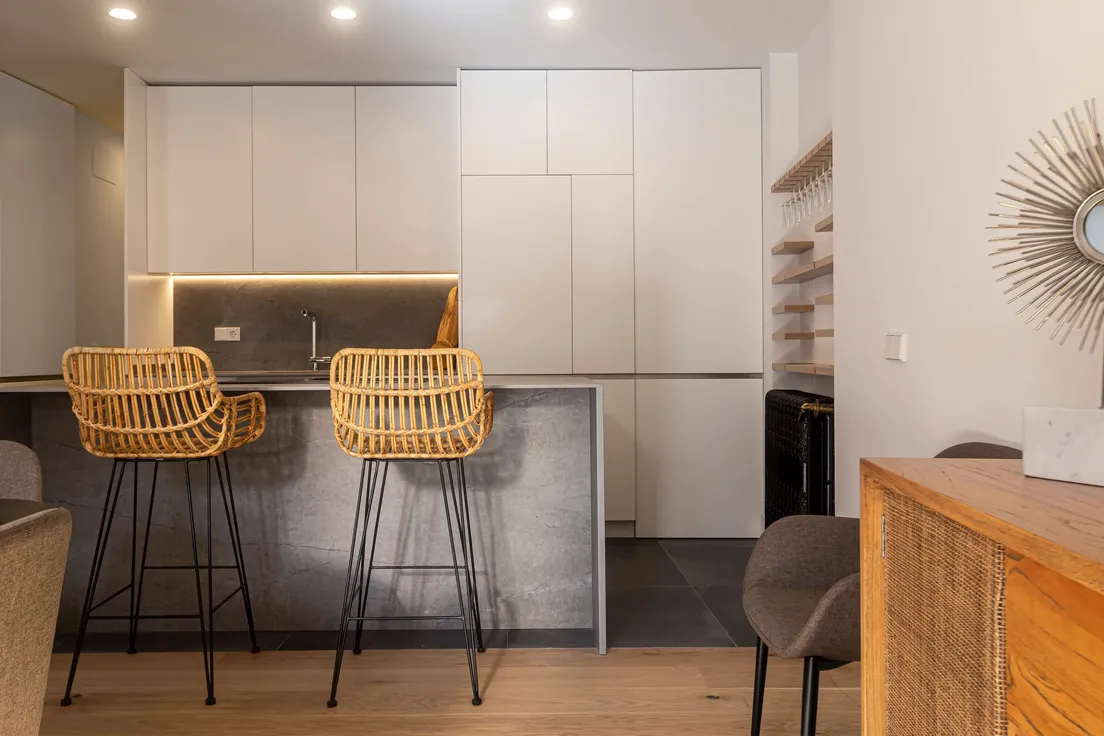
Photo by Gabriela Pons on Pexels
The Honest Math: What a Modern Rustic Farmhouse Kitchen Refresh Actually Costs
Here’s the honest math, added up instead of estimated: black cabinet hardware ($60), a black faucet ($120), two open shelves with brackets ($90), a rattan bar stool pair ($140), and a peel-and-stick shiplap accent section ($35) comes to $445 — the highest-impact changes on this list, none of which touch plumbing beyond the faucet swap. A cheap version and a splurge version both exist here: skip the faucet and lean on thrifted hardware and shelving brackets, and the same list lands closer to $200; add a real farmhouse sink and a butcher block run instead, and it climbs past $1,200. Neither is wrong — the honest number depends on whether you’re touching the sink and counters or just the surface layer.

Photo by Karola G (kaboompics.com) on Pexels
Rule of Thumb: Pick One Farmhouse Kitchen Design Move and Commit
You don’t need twelve farmhouse ideas running at once — you need one, done well, so the kitchen reads like a decision instead of a mood board that never got edited. Start with hardware and a faucet if the budget is tight; start with the sink if you’re touching plumbing anyway and want the one change that reads as a full kitchen update. Everything else on this list layers on top once that first move is in and you’ve lived with it for a week or two. A classic farmhouse kitchen from a decade ago meant all-white and matching; a modern farmhouse style kitchen today means picking a handful of these farmhouse kitchen ideas and mixing them with whatever’s already working in the room. If a bold color palette over reclaimed wood sounds more like your speed than farmhouse neutrals, our dopamine decor guide covers the opposite direction of the same “make it feel like yours” instinct.

Photo by Sosey Interiors on Unsplash
Frequently asked questions
Is modern farmhouse kitchen style still popular in 2026?
Yes — it's shifted, not faded. The heavy, all-neutral farmhouse look from the early 2010s has given way to a mixed-material version: warmer wood tones, black or bronze hardware instead of nickel, and one or two bolder color moves instead of an all-white kitchen. The bones (shaker cabinets, apron sinks, natural wood) are staying; the styling around them keeps evolving.
What are the pros and cons of a rustic modern farmhouse kitchen?
The upside: it mixes clean, functional cabinetry with warm, textured materials, so it reads collected instead of showroom-new, and most of the individual elements (paint, hardware, open shelving) are cheap to try. The downside: done all at once, it can tip into theme-park territory — the fix is picking two or three elements, not all twelve, and letting the room breathe.
What defines a modern rustic farmhouse kitchen?
Clean-lined cabinetry (shaker doors, simple hardware) paired with at least one obviously rustic material — reclaimed or stained wood, a farmhouse sink, exposed beams, or a woven texture. The modern half keeps the room functional and current; the rustic half keeps it from reading like a builder-grade showroom kitchen.
What kind of countertops and cabinets work best in a modern rustic farmhouse kitchen?
Butcher block or a light quartz that mimics soapstone both read farmhouse without the upkeep of real stone. For cabinets, painted shaker doors on the uppers and a stained or darker wood tone on the lower cabinets or island is the most common combination — it's also the easiest version to do in stages on a budget without a full kitchen remodel.
What's the difference between modern farmhouse and rustic farmhouse style?
Modern farmhouse leans cleaner and cooler — white or light gray cabinets, black hardware, simple lines, minimal ornamentation. Rustic farmhouse leans warmer and more textured — visible wood grain, wrought iron, woven baskets, less symmetry. Most real kitchens (including everything in this article) land somewhere between the two rather than picking a hard side.