
Bathroom
Powder Room Ideas That Don't Read Like an Afterthought
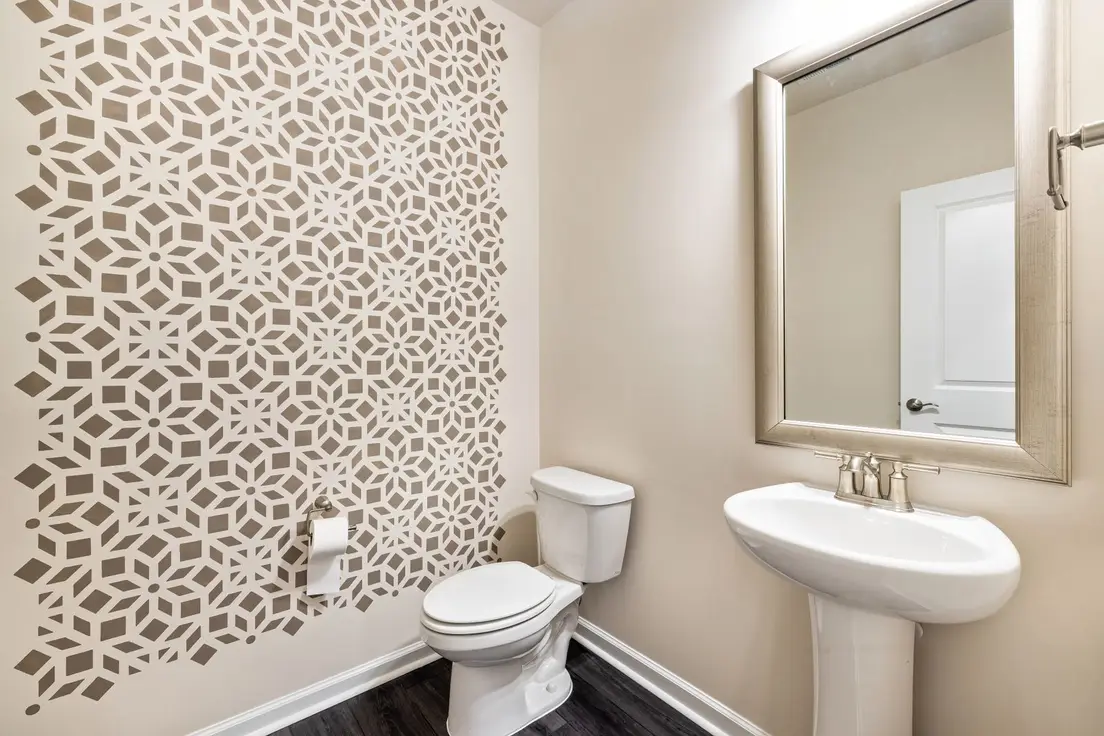
Photo by Curtis Adams on Pexels
The best powder room design ideas treat the room’s size as an advantage, not a limitation: it’s small enough that one bold wallpaper, one saturated paint color, or one statement mirror sets the tone for the entire design in a single glance. Most of these eleven ideas are decorating ideas you can finish in a weekend, not a full powder room remodel or reno, and the honest math at the end adds every real price into one number instead of leaving you to guess. These small powder room ideas scale down further for the tightest half baths. Go louder here than you would anywhere else in the house — nobody’s brushing their teeth in this room for twenty minutes a day, so there’s no vote from a groggy 7 a.m. self talking you out of the bold color.
A powder room (also called a half bath or half bathroom) is just a toilet and a sink, no shower or tub, which is exactly why it rewards commitment instead of restraint. It’s usually the smallest room in the house — a typical powder room runs 15 to 20 square feet — so a single strong decision (paint color, wallpaper, a patterned tile floor) reads as the whole design instead of competing with six other choices the way it would in a full bathroom. That’s the case for treating it as a low-stakes space to try the bold, slightly glamorous move you’d hesitate over anywhere else — a small space forgives a big swing better than a large one does. Mix a modern fixture with one old-world detail (an ornate mirror frame, a vintage-style faucet) and the room reads like a considered plan, not a random mood board. For vanity ideas and storage at a bigger scale, our small bathroom ideas guide covers the small full-bathroom version of this same list, and our small bathroom ideas on a budget has the cheapest version of a bathroom refresh if the budget is the whole story this month. If bold pattern and color are the actual draw, our dopamine decor guide is the wider version of the “why not” argument made below room by room.
Go Bold With Wallpaper on Every Wall
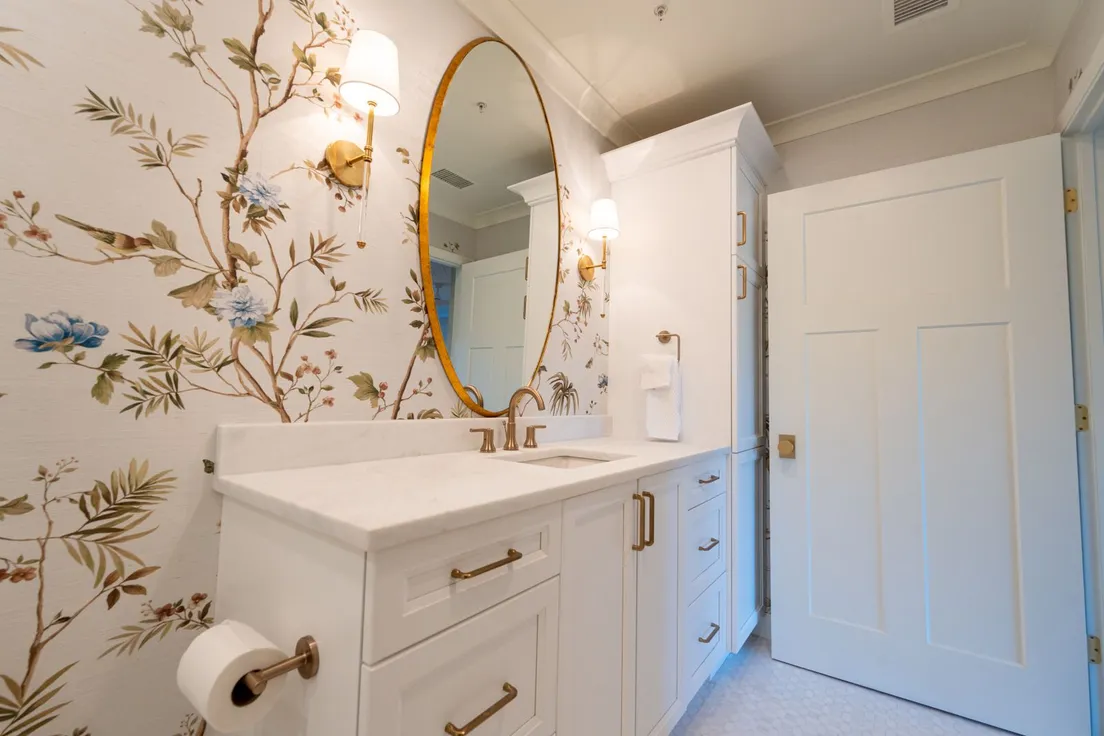
Paper all four walls, not just one accent wall — a half bath has no “across the room” for a busy pattern to overwhelm, so the usual one-wall caution doesn’t apply here. A large-scale mural print reads just as stylish as a smaller repeat and is often the same price per roll, so decorate with whichever scale actually matches the art on hand, not the safer-looking option. A grasscloth or vinyl paper runs $60–120 a double roll, and most powder rooms need 2–3 rolls total, landing the whole job under $300 including paste and a smoothing tool. If full commitment feels risky in a rental, a peel-and-stick version does the same visual job and comes off clean at move-out. (Measure the actual walls before ordering — a room this small still eats more roll than feels right, because you’re paying for pattern repeat, not square footage.)
Clad One Wall in Wood Paneling or Wood-Look Tile
Vertical wood-look panels or plank tile behind the toilet add real texture and visual interest without adding a single decor object — an upgrade from flat painted drywall that survives a damp room better than real wood. Keep the baseboard the same white trim as the rest of the room, so it reads as a deliberate powder room decor choice, not a patch job. Wood-look porcelain plank runs $3–6 a square foot, and a powder room’s small wall footage keeps the material cost under $150. Builder-grade paneling from a big-box store reads like a rec room from 1998; the wood-look tile version, laid full-height, reads like that rec room never happened.
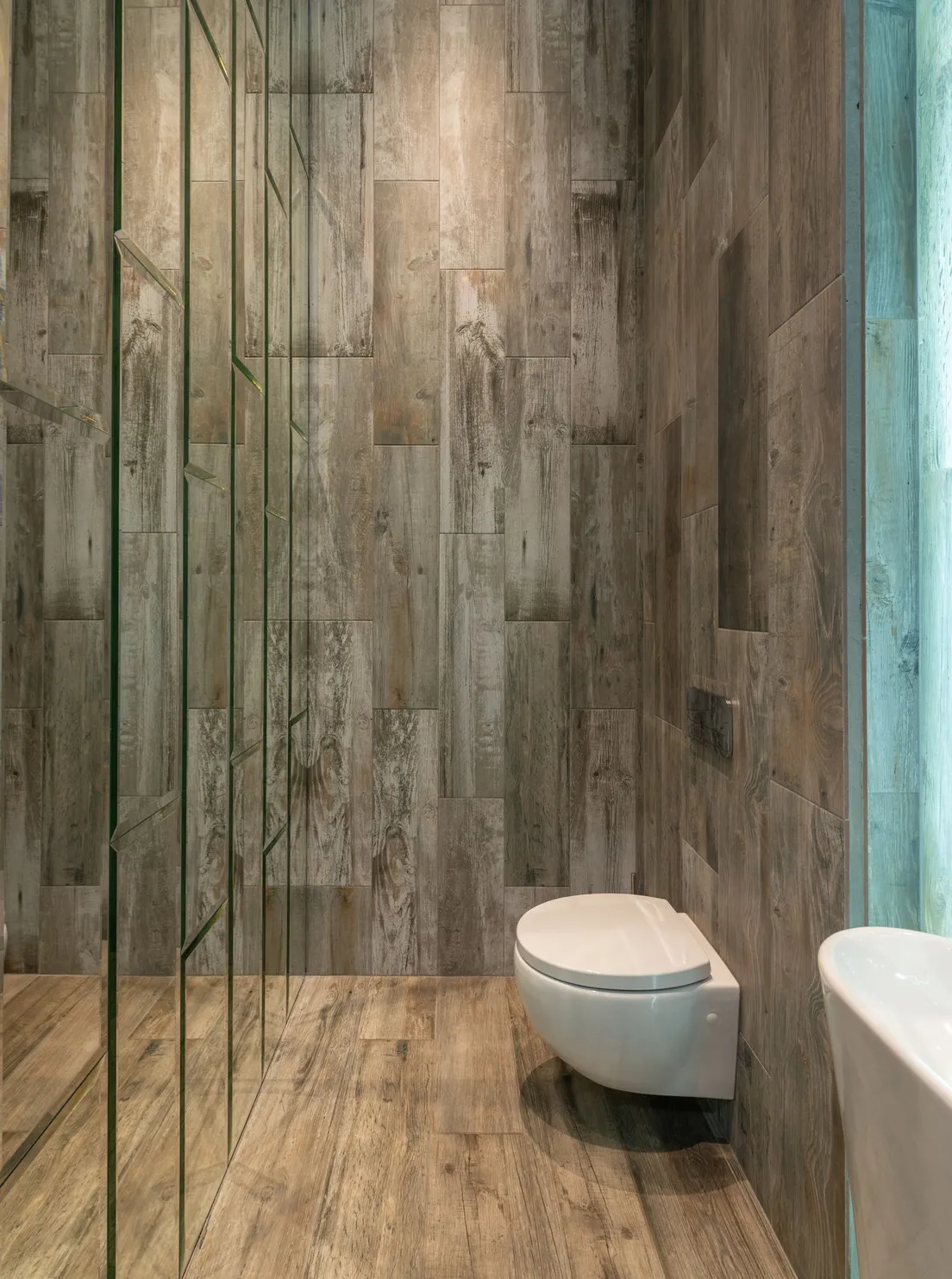
Photo by Max Vakhtbovych on Pexels
Choose a Vessel Sink for the Half Bath Vanity
A vessel sink sits on top of the countertop instead of set into it, which objectively does less — it holds water above the surface instead of below it — and that’s exactly why it reads as the pricier choice. A quality ceramic or stone-resin vessel bowl runs $90–180, paired with a taller vessel-height faucet ($80–150) since a standard-height faucet will undershoot the bowl. An integrated sink and countertop, molded as one piece, is the low-key alternative if a vessel feels like too much upkeep — it never shows the water-spot buildup a glass vessel bowl does. A floating vanity shelf under it — clean lines, no visible cabinet base — costs less than a full bathroom vanity and shows floor space underneath, the same “the room looks bigger” trick a pedestal sink pulls off elsewhere.
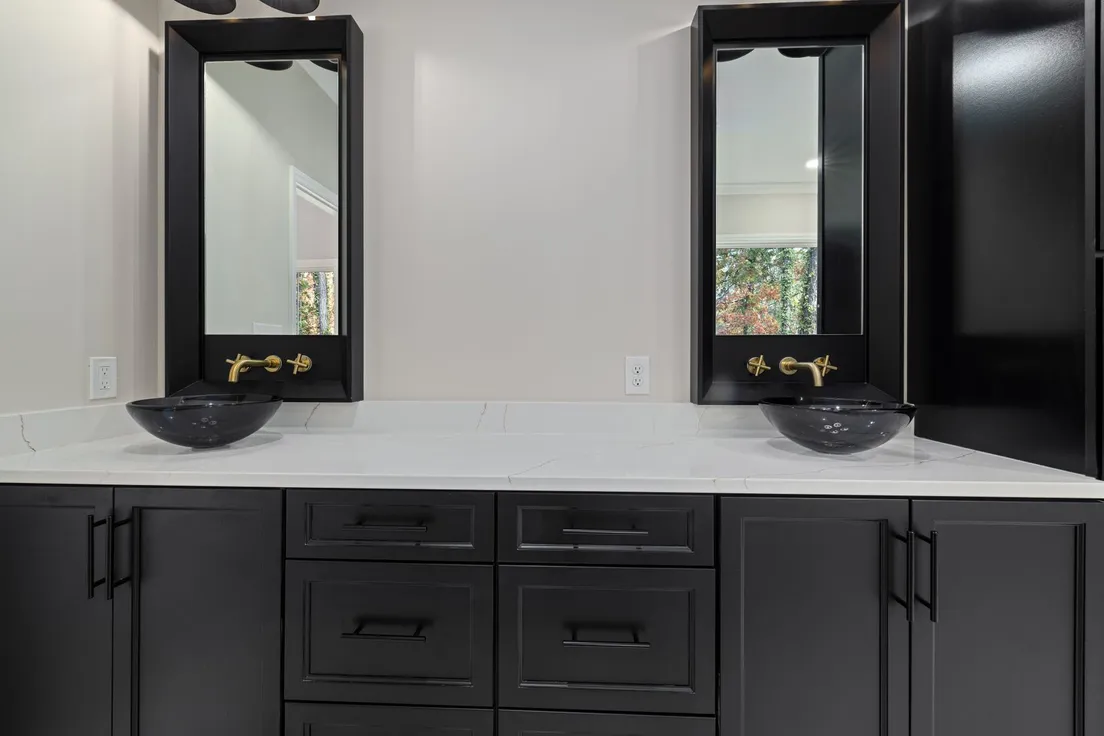
Photo by Curtis Adams on Pexels
Swap In Brass or Matte Black Fixtures
The faucet, towel ring, and toilet paper holder are small parts, but they’re the parts guests actually touch up close — a brushed brass or matte black set ($60–140 for all three, bought as a matched trio) gives even basic laminate countertops a luxe edge and reads deliberate in a way mismatched builder chrome never does. Chrome is the answer everyone already has; brass is the one guests remember. Buy the set together rather than piecing it from three listings — finish tone varies more between brands than photos suggest, and a “brass” ring next to a “warm brass” faucet can clash more than two different metals would.
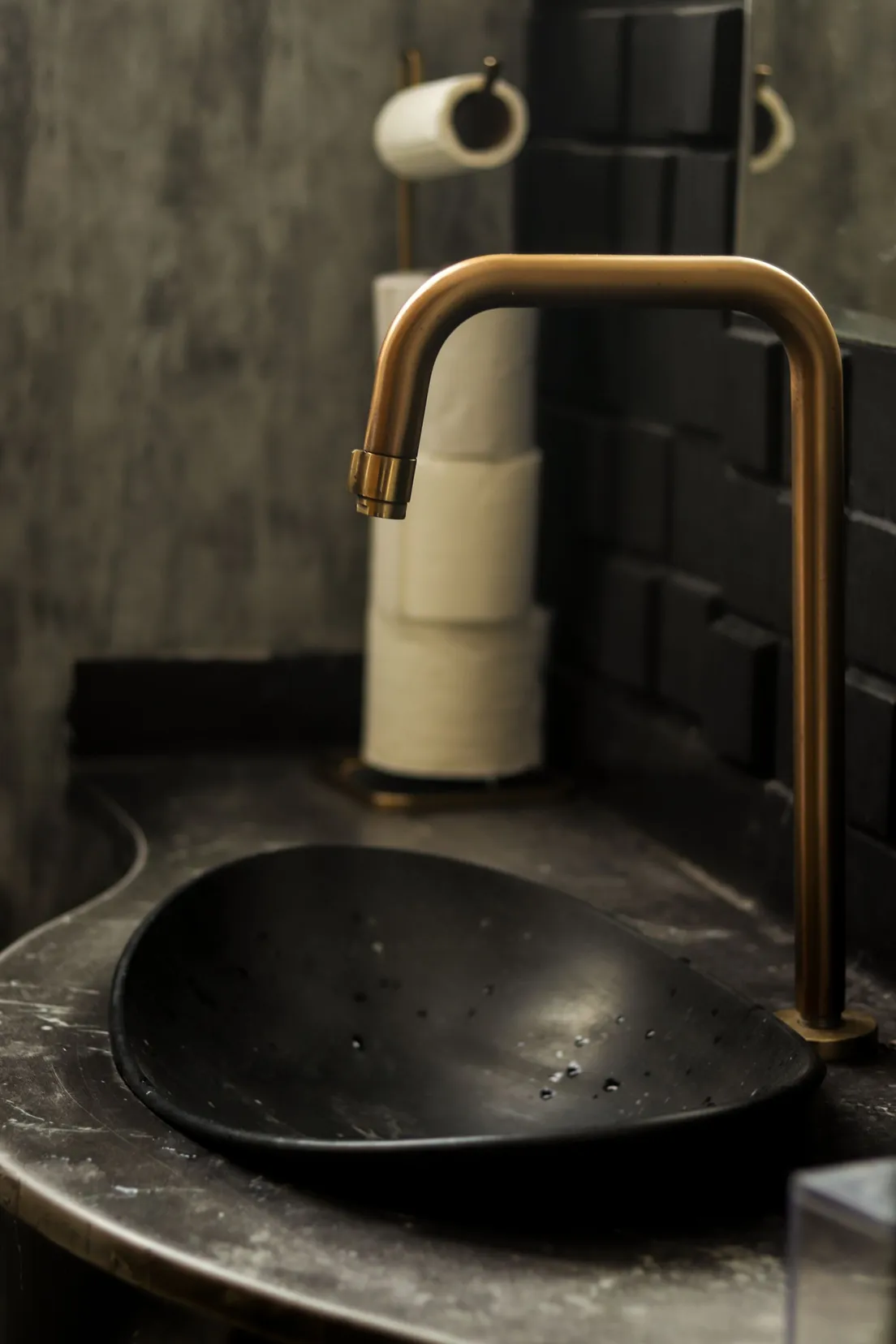
Photo by Guilherme Simão on Pexels
Hang a Round or Arched Statement Mirror
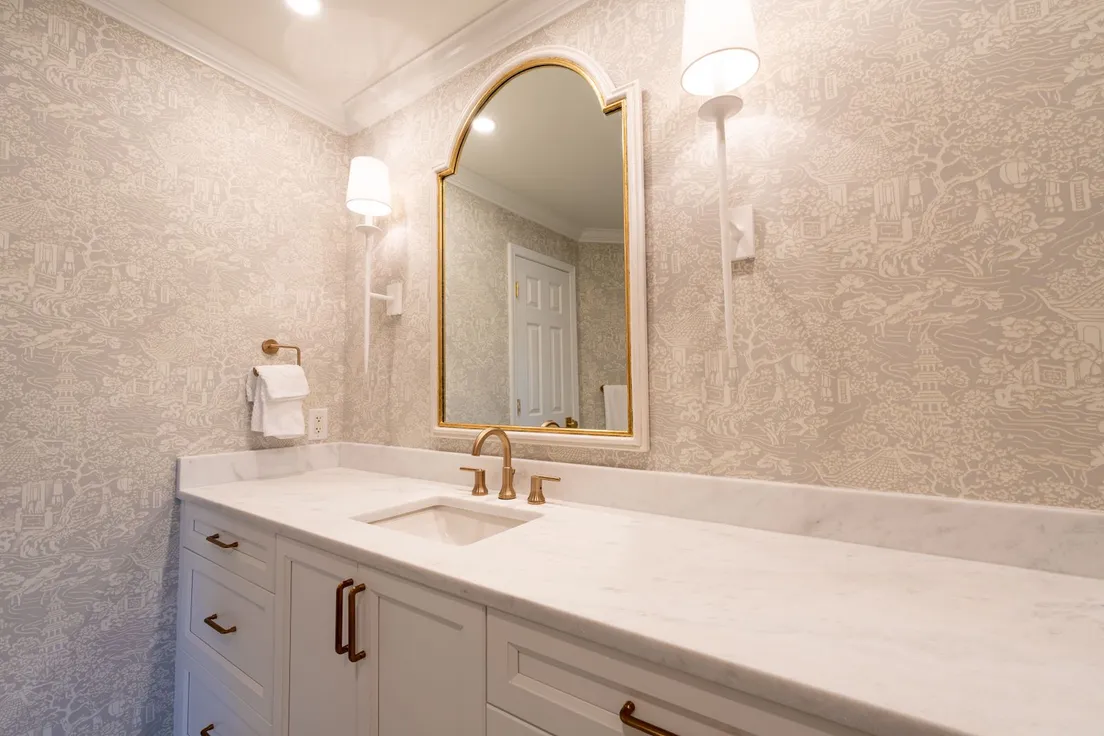
Skip the plain rectangular builder mirror bolted edge-to-edge across the vanity — an oversized round or arched mirror with a real, slightly sculptural frame ($80–200) does more for the room than almost anything else on this list, because it’s the one object at eye level guests look directly at while washing their hands. Size it to roughly two-thirds the width of the sink, centered over the faucet, not the whole wall. We’ve eyeballed “level” more than once instead of grabbing the actual level six feet away. The wall never forgives it — anything over a few pounds wants a real screw into a stud or a rated drywall anchor, not a command strip.
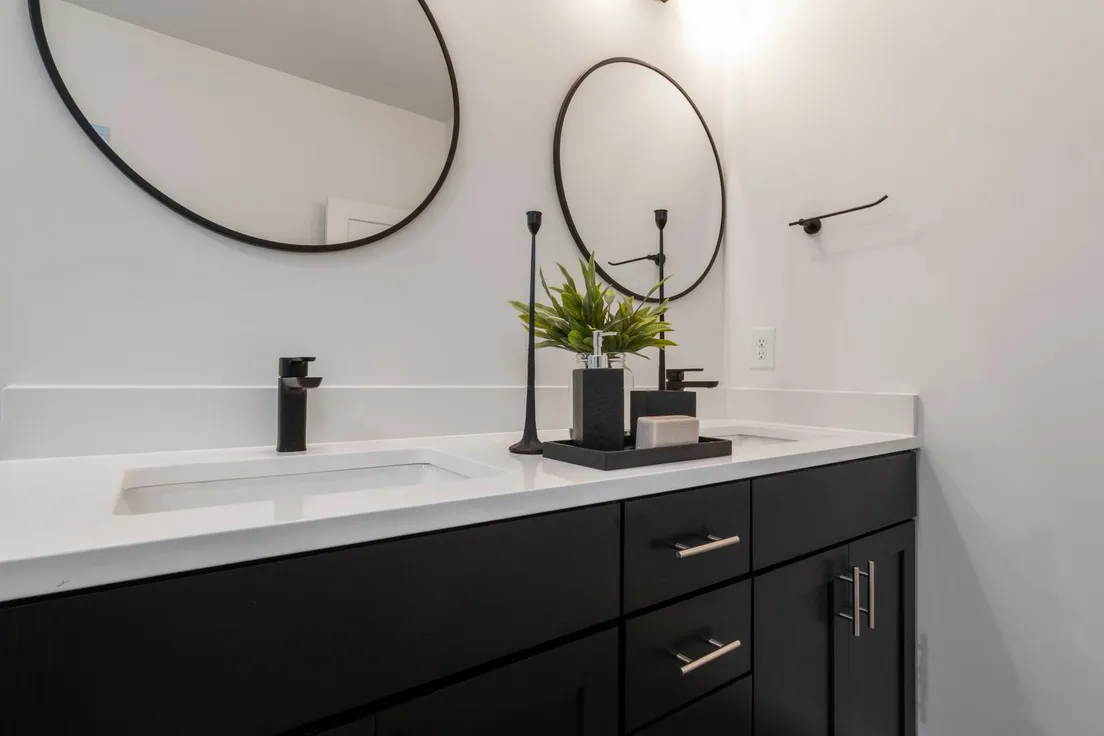
Photo by Curtis Adams on Pexels
Flank the Mirror With Wall Sconces
Paint and lighting solve more problems than new furniture does, and nowhere on this site is that truer than a windowless powder room lit by one flush-mount ceiling light and nothing else. One bulb pointed straight down casts shadows under the eyes like an airport bathroom; two sconces mounted at face height on either side of the mirror light the face evenly, the way a nice restaurant bathroom does. A pair of hardwired or plug-in sconces runs $70–160 total, and swapping the existing light fixture’s bulbs to warm 2700K is a $9 fix if new sconces aren’t in the budget this month — lighting alone changes the room feel more than almost any other single swap on this page. Hardwired sconces need an electrician; plug-in versions with a cord channel skip that step entirely.
Commit to One Bold Powder Room Wall Color
A saturated wall color — deep green, navy, terracotta — does the same “small room, big statement” job as wallpaper for a fraction of the cost: about $45 for a gallon of quality paint, which is usually enough for the whole room plus the ceiling. Green walls with a beige tile floor is one dependable pairing; an all-white, nearly monochrome room with one black fixture is the quieter opposite move. A windowless room loses natural light fast, so test the paint chip under the actual bulb going into the fixture, not daylight from another room. We’ve painted over a landlord’s “eggshell” three coats deep before finding out the original coat was a stain-blocking primer in disguise — a $4 tester swatch would’ve caught it before the second coat, not after the third. If the home was built before 1978, check the EPA’s lead-safe renovation rules before sanding or scraping any existing paint layer, not just this one.
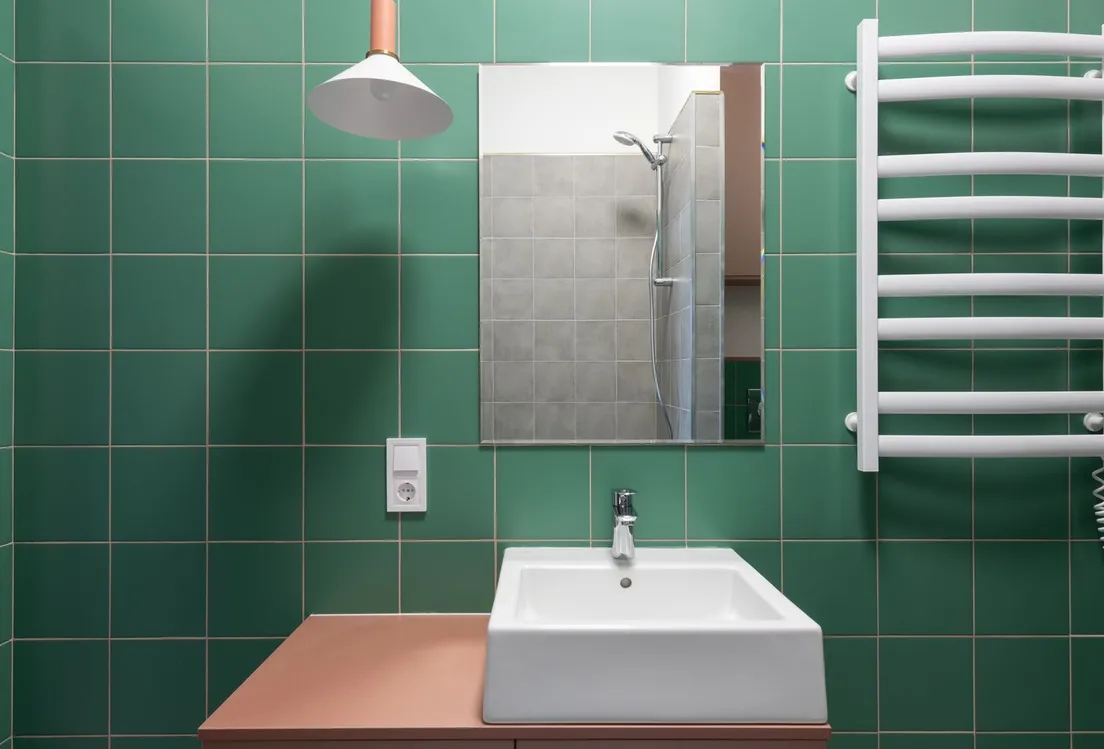
Photo by Max Vakhtbovych on Pexels
Lay Down Patterned or Checkerboard Floor Tile
A patterned or checkerboard tile floor costs about the same as a plain one and looks like it cost twice as much — the pattern does free visual work that a solid color can’t. Basic 12×12 checkerboard porcelain runs $3–5 a square foot, and a powder room’s tiny floor footprint (most run 15–20 square feet total) keeps the full material cost under $100 before installation. A mosaic tile floor is the higher-effort, higher-cost alternative — smaller pieces mean more grout lines and more labor if it’s not a DIY job, but the same bold-pattern payoff. This is also the one idea on this list worth hiring out if grout lines aren’t your strong suit — a crooked checkerboard pattern is more visible than a crooked plain tile job, and it’s the first thing anyone standing at the sink looks down and sees.
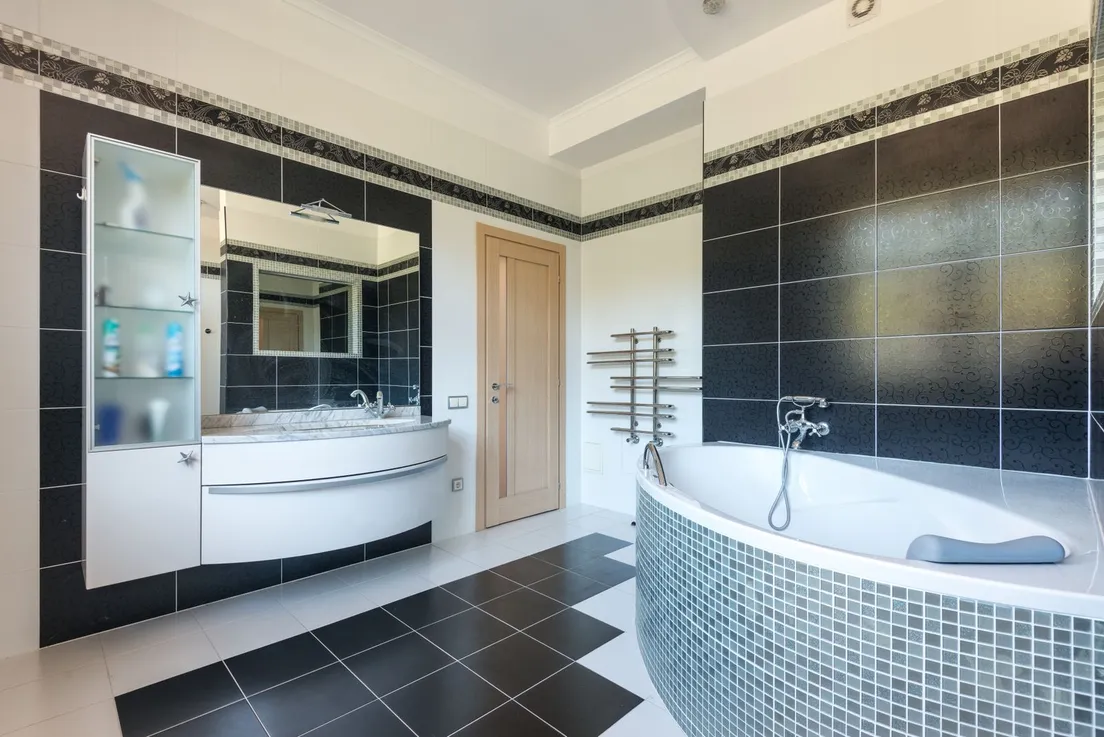
Photo by Max Vakhtbovych on Pexels
Keep Powder Room Storage Small but Deliberate
A powder room doesn’t need a linen closet — it needs one shelf or ladder rack near the sink holding the guest hand towel and a spare roll of toilet paper, full stop. A small wall-mounted or freestanding towel ladder runs $30–70 and solves the entire storage question in one purchase; wall-mounted saves floor space, freestanding skips drilling into a rental wall. Our shelves collect decorative candles faster than anyone lights them; one good shelf with a folded towel reads more finished than the same shelf styled with six small objects competing for attention.
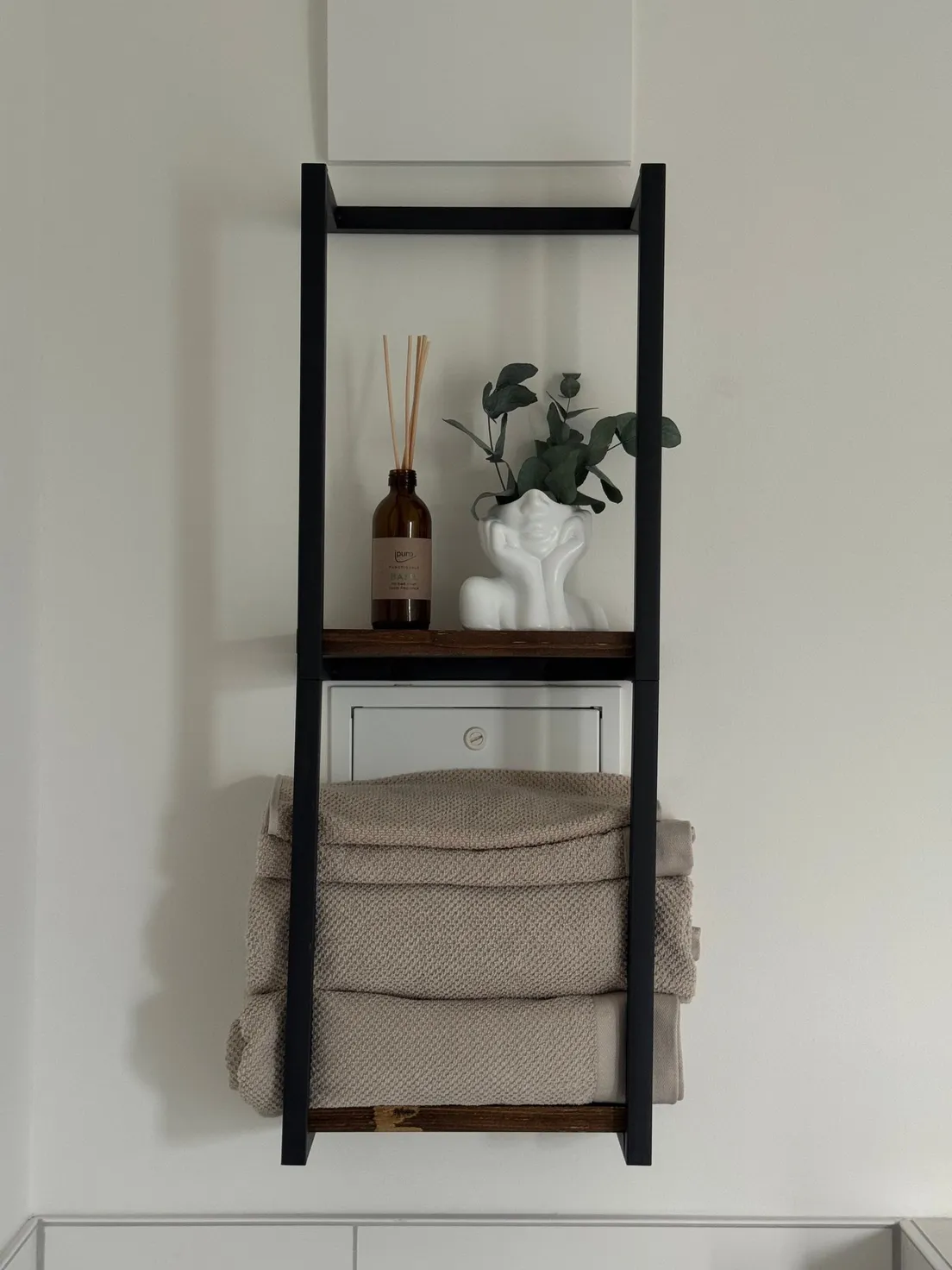
Photo by Marina Endzhirgli on Pexels
Repeat One Warm Wood Tone at the Vanity
If the bathroom vanity is wood, pick one tone — honey oak, walnut, or light ash — and don’t fight it with a second wood tone nearby. Two different wood tones in a room this size reads like leftover furniture pushed together; one tone, repeated across the wood vanity and a single accessory, reads like an actual plan. A basic light-oak vanity runs $220–380 unassembled, paired with brass or matte black hardware, not brushed nickel, which fights warm wood tones. The same rule holds if the vanity is painted instead of stained — a green vanity with brass hardware follows identical logic. A homeowner doing a full remodel can build this in from scratch; a renter gets the same look from a $30 can of cabinet paint on the existing box.
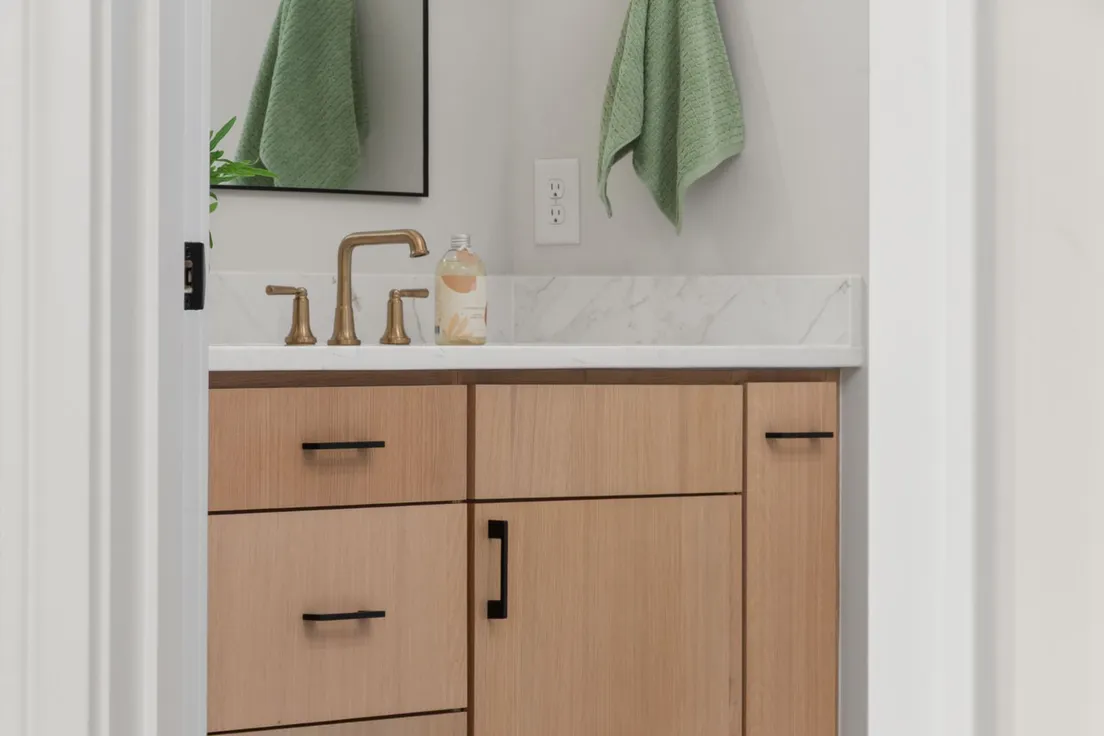
Photo by Curtis Adams on Pexels
Solve a Tiny Layout With the Right-Sized Fixtures
Most powder rooms run 15–20 square feet, small enough that a wall-hung or corner sink instead of a full vanity is the difference between a room that feels planned and one that feels apologized for. A compact wall-mounted sink runs $90–160 and gives back 6–10 inches of walking room compared to a standard 24-inch vanity cabinet — real space in a genuinely tight space. Wall mounted toilets do the same job for the floor around the bowl, but cost more and need a plumber — save that one for a full remodel, not a weekend project. This is the one bathroom set aside for guests to use, so walking clearance matters more here than in a private small space nobody else sees. If the room has no window, building code (per the Home Ventilating Institute’s sizing guidance) recommends at least 1 CFM of exhaust fan capacity per square foot of floor area, with a 50 CFM minimum even in the smallest rooms.
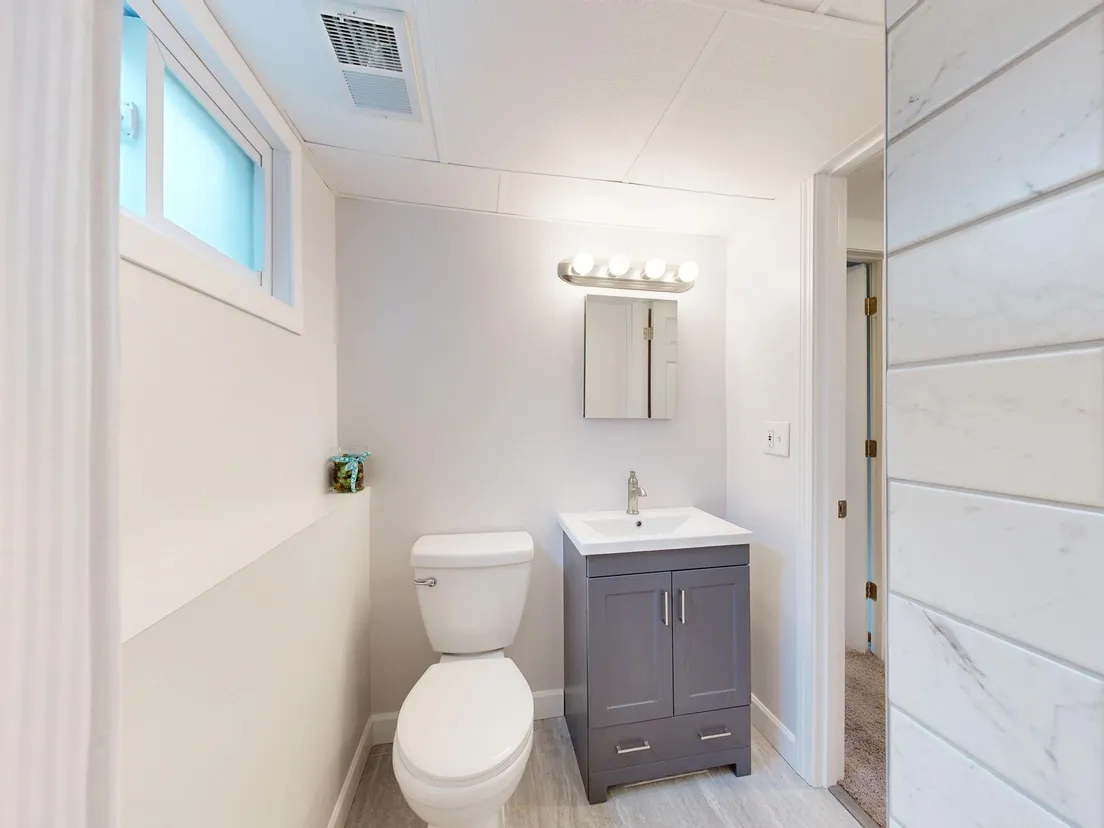
Photo by Peter Vang on Pexels
Here’s the honest math: the cheapest version of this room — a $9 warm-bulb swap, a $45 gallon of bold paint, and a $30 shelf — comes to $84 and takes an afternoon. Add wallpaper instead of paint ($280), a brass fixture set ($100), and a new mirror ($140) and the number moves to $520 for a room that reads fully finished. Do all eleven ideas, vanity and tile floor included, and it tops out around $1,850 — less than most single vanity replacements alone at full retail. If the budget stretches to just two ideas, start with the paint and the sconces — everything else looks more deliberate once the room already reads intentional instead of beige.
Frequently asked questions
What are the current trends for powder rooms?
Full-room wallpaper (not just an accent wall), unlacquered or brushed brass fixtures, vessel sinks on a floating shelf-style vanity, and one saturated wall color instead of a safe neutral. The common thread is treating the powder room as the one room in the house allowed to be a little much.
How do I make a powder room look expensive?
Spend on the two things guests actually touch and look at closely: the faucet and the mirror. A $180 brass faucet and a $150 framed mirror read more expensive than a $2,000 vanity with builder-grade chrome hardware. Layered lighting (a fixture plus sconces, not one overhead bulb) does the rest for under $100.
What should be in a powder room?
Legally and practically: a toilet, a sink, a mirror, task lighting, a hand towel, and toilet paper within reach of the toilet. That's the whole functional list — everything else on this page (wallpaper, tile, a vessel sink) is decor layered on top of those basics, not a requirement.
What's the difference between a powder room and a full bathroom?
A powder room, or half bath, has a toilet and a sink only — no shower or tub. A full bathroom includes at least one bathing fixture. The size difference is real too: most powder rooms run 15–20 square feet, small enough that one bold decision (paint, paper, tile) reads as the whole design instead of getting lost.